
I get asked all the time: “Which machine should I rent?” or “Why don’t you just bring the bigger excavator for this?” And when it comes to small trench work — waterline repairs, drain tile, low-voltage cabling, irrigation, fence posts, small drainage — my answer almost always comes back to the same machine.
The Bobcat E10.
Here’s why, in plain terms — from someone who runs these every week on Mid Vancouver Island properties.
The Short Answer
For small trench work (under 12 inches wide, under 3 feet deep, most residential drainage and utility runs), a Bobcat E10 wins over a full-size excavator on almost every metric that matters to a homeowner:
- Cleaner cuts = easier repair and backfill
- Less collateral damage to your lawn, driveway, and landscaping
- Fits through gates and side yards most bigger machines can’t touch
- Less compaction of surrounding soil — no giant tracks
- Cheaper day rate — and often faster job completion
- You can work close to structures without risking hitting them
Read on for the details — this stuff matters more than most people realize.
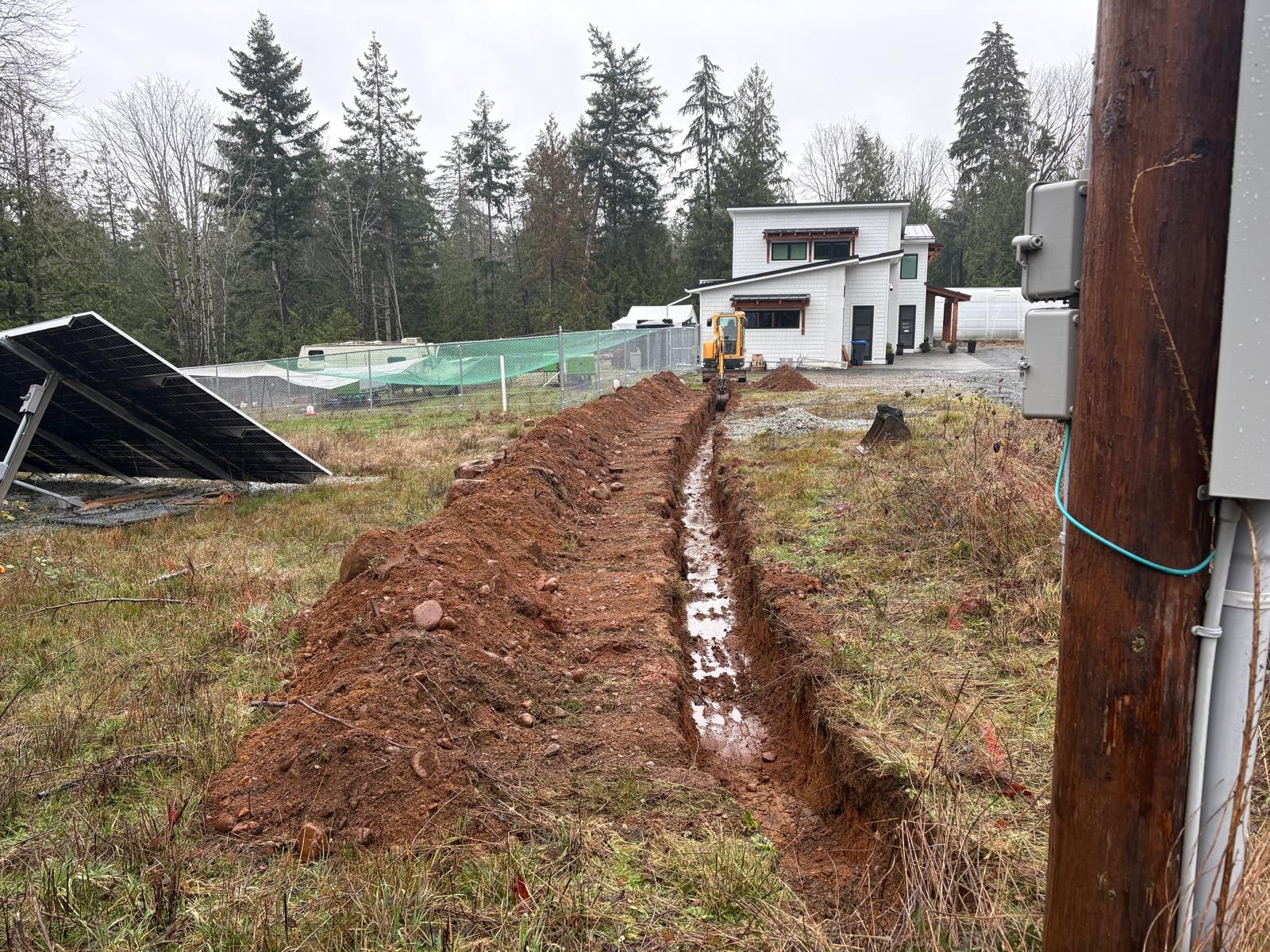
The Problem with Using a Big Excavator for a Small Job
When you dig a trench with a big machine (Bobcat E35, Hyundai 25+, or anything larger), you’re moving a lot more dirt than you actually need to. That sounds fine — dirt is just dirt, right?
It’s not. Here’s what over-digging costs you:
More material to backfill
A wider trench means more soil to shovel back in, more compaction work, and more settling risk. If you’re running a waterline in a landscaped yard, that big trench turns into a big scar that needs weeks to settle before you can plant grass again — and even then, you’ll see the line for months.
More surface disturbance
Bigger machines have bigger tracks. Those tracks compact your lawn, crush irrigation lines you didn’t know were there, and leave ruts that take a season to grow back. On a landscaped Mid Vancouver Island property — especially in Nanoose Bay, Fairwinds, or the newer Parksville developments — that damage adds up fast.
More risk to underground utilities
A bucket that’s 24” wide can catch a utility line the operator didn’t see. A bucket that’s 8” wide (E10 size) can work AROUND known lines cleanly. In the RDN, BC One Call is mandatory before any dig, but even after locates, the smaller machine gives you more room to maneuver around what’s marked.
Higher rental cost
An E10 at $250/day is significantly less than an E35 at $375/day or a full-size at $450+. Over a 3-day rental, that’s real money. And here’s the thing — for small trench work, the E10 doesn’t take longer. It often takes less time because it’s not fighting extra material.
Where the E10 Really Shines
Here are the specific job types where I always reach for the E10 first:
1. Waterline trenches
Small-diameter waterline (3/4” to 1”) between the meter and the house, or repairs to a leaking section, need a narrow, clean trench. E10 cuts a 6–8” wide slot exactly where you want it. Fixing the leak, replacing the section, and backfilling takes half the time compared to fighting a wide, ragged trench.
2. Drain tile and perimeter drainage
Running drain tile around a foundation or a low spot in the yard? The E10 fits between the house and the fence line, follows the wall closely, and doesn’t beat up your foundation plantings.
3. Low-voltage cable and irrigation
Landscape lighting, garden irrigation, security cabling — all shallow trenches (6–18”). The E10 is perfect. A full-size machine is massive overkill and you’d be re-doing landscape work for weeks.
4. Fence post trenches
Setting a run of fence posts, especially on a property line where you can’t afford damage to the neighbor’s side? The E10 gives you precision. You can dig each post hole cleanly without dragging tracks across the neighbor’s lawn.
5. Small septic drain field repairs
Not the whole field — but a repair section or a leaky lateral. The E10 fits between existing components and doesn’t compact the field beds around the repair.
6. Access-limited backyards
This is the big one. If your backyard is fenced with a standard 36” gate, most machines can’t fit through. The E10 can. That means we can work on drainage, waterlines, or small demo in your fenced backyard without having to remove a section of fence — a huge time and cost saver.
I wrote more about this specifically here: Bobcat E10 vs a full-size excavator for backyard jobs.
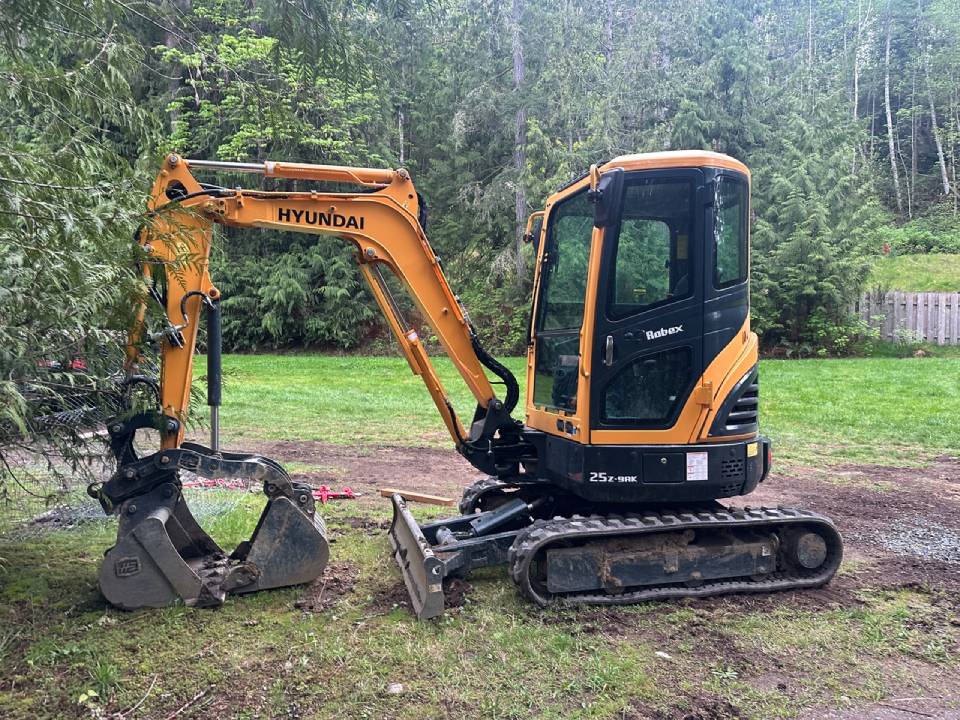
The One Thing People Get Wrong About Mini Excavators
I hear this a lot: “It’s small so it must be slower or weaker.”
Not really. For the jobs it’s designed for, the E10 is faster than a bigger machine because:
- The bucket load matches the trench width — no wasted arm swings
- Less setup and maneuvering time between passes
- No damage repair after the job (which people forget adds hours or days)
- Precise reach means fewer re-dig passes
Where the E10 is NOT the right choice:
- Big excavations (foundations, ponds, basements)
- Deep trenches (over ~5 feet — reach is limited)
- Heavy material handling (large boulders, big stumps)
- Large driveway installs where volume matters
For those, we use the Bobcat E35 or the Hyundai 25. Different tool for different job.
Real Job: The Kind of Trench Where E10 Wins
Here’s a job we did recently that illustrates the difference. Customer needed a new hose bib run to the back corner of their yard — about 60 feet of trench, 18” deep, past two garden beds and around a small patio.
With a full-size excavator: we’d have needed to remove a fence panel, roll the tracks across the lawn (compaction damage — 2–3 weeks to recover), dig a 24”+ wide trench (twice as much backfill), and probably clip an existing irrigation line.
With the E10: we came through the gate, worked between the garden beds, dug a 6” trench, ran the line, backfilled, and the customer couldn’t see where we’d been within a week.
Same result. Half the mess. Faster. Cheaper.
That’s why it’s my favorite machine for small trench work.
When to Rent vs. When to Hire
We offer both:
Rent the E10 yourself
- $250/day, $700/week (3-day rentals become week rentals — plus free delivery)
- Best if you’re a DIYer with some machine experience
- Best for shorter jobs (waterline swap, small drainage, fence post run)
- We deliver and pick up
Full details: Bobcat E10 rental page
Hire us to run it
- We bring the machine, we do the work
- Best for utility trenches where accuracy matters
- Best if you don’t want to learn a machine for a one-time job
- Comes with our operator experience and BC One Call compliance
Call 778-909-9874 and I’ll help you figure out which makes sense.
Related Reading
- Bobcat E10 vs a full-size excavator for backyard jobs
- BC One Call: when you MUST locate before digging
- How to prep your yard for a deck or patio
- When a bin AND excavation together save you money
Frequently Asked Questions
How wide is the trench a Bobcat E10 digs? Standard bucket is 6–8”. You can swap to narrower or slightly wider buckets depending on the job. This matches most residential utility trench needs.
How deep can the E10 dig? About 5 feet at maximum reach. For most residential drainage, waterline, and cable trenches (under 3 feet), it’s more than enough.
Can the E10 fit through a standard fence gate? Yes. It’s designed to fit through 36” openings, which is standard for residential side-yard access. That’s one of its biggest advantages over a full-size machine.
Is the E10 hard to operate? It’s the friendliest mini excavator we run. If you have any equipment experience (even ride-on mowers or a bobcat), you’ll pick it up quickly. Rental comes with a walkthrough.
Does All Canadian offer both rental and operator services? Yes. We rent the E10 to DIYers ($250/day) and we also run it ourselves for customers who prefer to hire the work out. Combined jobs (excavation + bin) usually get bundled pricing.
What’s the delivery fee for the E10 in Parksville? $50 to Parksville, $75 to Qualicum Beach or Nanoose Bay. 3-day+ rentals get free delivery as a standing promo.